Gambling phrases are woven into everyday English at every level, from the casual to the boardroom. When a colleague says she'll hedge her bets, or a manager announces he's going all in on a strategy, neither of them is thinking about cards or dice. The language has long since crossed over. Knowing where these phrases come from sharpens both how you use them and how you read them when they appear in someone else's writing.
Phrases from card games
Card games, especially poker, have contributed more to everyday English than almost any other source. The concept of a poker face is now so embedded in professional life that it appears in performance reviews, negotiation guides, and leadership coaching. The phrase describes a controlled expression that gives nothing away, and it has travelled so far from its original context that most people reaching for it have never played a hand of poker.
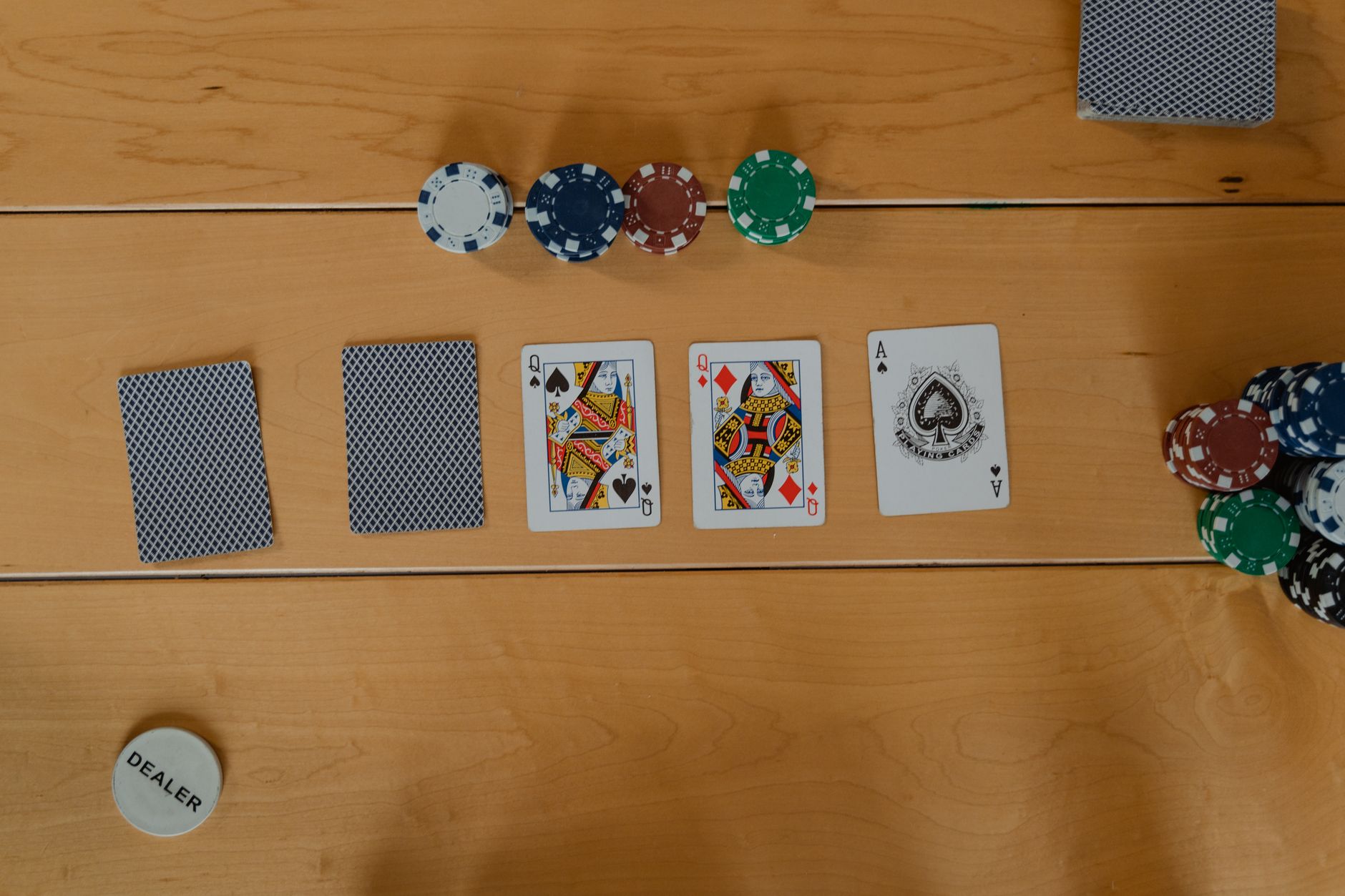
Ace in the hole comes from stud poker, where one card is dealt face-down. That hidden card is the hole card, and if it's an ace, the player holds a concealed advantage. Today the phrase describes any secret strength kept in reserve until the critical moment. Fold started at the felt too: a player who folds surrenders their hand rather than risking more money. In everyday writing it describes giving up or withdrawing under pressure, and the full register of "fold" matters when you're choosing whether the word fits a professional context.
Wild card originally meant a card that could represent any other, giving its holder unusual flexibility. The phrase now describes an unpredictable person or factor that can alter an outcome in ways nobody anticipated. Follow suit derives from card play too: when you must play a card of the same suit as the leading card, you follow suit. The modern meaning, to do what someone else has just done, keeps that logic almost intact.
Up the ante raises the stakes before a game begins. In professional life it means to escalate the demands or the costs of a situation, often in a negotiation. Its near-relative ante up means to contribute what is owed before play can proceed. Both sit comfortably in business writing as long as the context is clear.
Phrases from dice games
Dice games are older than card games by several thousand years, and their vocabulary has had longer to settle into the language. Roll the dice is the most transparent of the group: it describes accepting an uncertain outcome, acknowledging that the result is partly beyond your control. The phrase carries no negative connotation on its own. It simply names the act of choosing to proceed despite uncertainty.
No dice is less obvious. It means a refusal or a failed attempt, and its origin is disputed. One credible account ties it to early 20th-century American courts, where judges refused to admit evidence from dice games because gambling was illegal. A case without admissible dice evidence was a case that went nowhere. The phrase now travels anywhere a request meets a flat refusal.
The die is cast is the oldest phrase on this list. Julius Caesar reportedly said the Latin equivalent (alea iacta est) when he crossed the Rubicon in 49 BC, committing to a course of action he could not reverse. The die in this phrase is a single dice, and once it's thrown the outcome is out of your hands. Writers use the phrase to mark the moment a decision becomes irreversible.
Phrases from horse racing and betting
Horse racing generated a cluster of phrases that describe probability and likelihood. A long shot was a horse given poor odds by the bookmakers. The phrase now describes any attempt that is possible but unlikely. Against all odds describes succeeding despite conditions that made failure the most probable outcome. Both phrases carry an implicit admiration for the improbable result.
Dark horse comes from racing too. A dark horse was an unknown or unregistered horse whose form hadn't been published in the race papers, making it impossible to handicap accurately. Bettors couldn't assess it, so they tended to ignore it. When the horse won anyway, the upset was dramatic. The phrase now describes any unexpected contender who outperforms low expectations, and it appears constantly in political commentary and sports journalism.
Hedge your bets describes protecting yourself against loss by supporting more than one option at once. The original meaning was financial: a bettor who hedged placed a secondary wager on a different outcome to limit the damage if the main bet failed. The phrase now applies to any situation where someone spreads their risk rather than committing fully. It's one of the most useful gambling phrases in professional writing because the idea of risk management translates directly.
Phrases from general gambling culture
Pass the buck traces back to poker. A marker called the buck (often a buckhorn-handled knife) was passed around the table to indicate whose turn it was to deal. A player who didn't want to deal passed the buck to the next person, shifting the responsibility. The phrase now means to redirect blame or duty onto someone else, and it's one of the most recognisable idioms in office life.
Go for broke comes from gambling slang and means to stake everything on a single attempt, holding nothing back. The phrase gained wide currency through the 442nd Infantry Regiment in World War II, a unit of Japanese-American soldiers who adopted it as their motto. Bet your bottom dollar describes certainty so complete you'd stake your last coin on it. Both phrases carry the energy of total commitment.
In the cards derives from cartomancy, the practice of reading fortunes from playing cards or tarot. If something was in the cards, the fortune-teller had seen it coming. The phrase now simply means that something is likely or expected to happen.
In spades comes from card games where spades is the highest-ranking suit. To have something in spades means to have it in abundance or to an extreme degree. Blue chip takes its name from poker as well: blue chips held the highest value at the table. In finance, the phrase describes companies of proven quality and low risk, which is exactly why it crossed so cleanly from the casino to the stock market.
Why these phrases stick
Gambling phrases endure because gambling itself involves the universal human experiences of risk, reward, decision-making, and uncertainty. Those themes map neatly onto almost every professional situation. A phrase like high stakes conveys the weight of a situation instantly, in two syllables, without requiring any explanation of the original betting context.
The phrases also tend to be visceral. Rolling dice, holding a hidden ace, folding your hand: these are physical actions with clear, concrete images attached. They give abstract ideas a shape. That's why a business writer reaches for them even in a document that has nothing to do with gambling. The image does work that plain language sometimes can't.
What matters in professional writing is knowing which phrases are still vivid and which have flattened into cliché. High stakes still works. It's in the cards still works. Going all in has been used so relentlessly in startup culture since roughly 2015 that it's nearly empty. The difference is whether the image behind the phrase still adds something, or whether the words have lost their edge entirely from overuse.